




Although the knowledge of home installation and distribution of water and electricity seems really very complex, so that non-professionals are confused, but in fact, the owner does not need to remember all the knowledge, as long as the more important, the owner’s future life has a greater impact on the knowledge content remember, or understand, in the supervision of workers construction can be used on the line. Other content that will not have much impact, rough, so that the burden of the owner will be relatively small, this is like the exam must first ensure the answer score, there is no need to waste too much time on the small question.
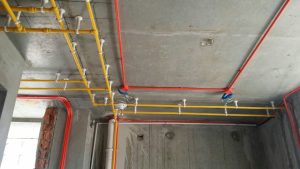
Before construction, there must be electrical (strong current, weak current), water supply and drainage design construction drawings. The threading tube should be of a certain size (thickness), not only to enable the wire to penetrate, but also to leave enough space so that the heat generated by the wire can be dissipated when it passes through a large current. The ratio of the cross-sectional area of the general wire to the cross-sectional area of the conduit is 1/3 to 1/. Do not plug the wire pipe. Lines with different voltages, different circuits, and different signals are strictly prohibited in the same threading tube. It is strictly forbidden to lay the wire in the wall, the floor, under the floor or on the ceiling without any protection.
The interface of each line should be smooth and the connecting plate should be firmly connected. The interface box of the power input box should be protected by a protective ring (locking nut). In order to update and maintain the wire in the future, the wire pipe buried in the wall, underground or ceiling, the curvature of the bend (that is, the cold bending radius) should be 5 to 10 times the diameter of the wire pipe. Do not connect a cable in a cable conduit. If the length of the cable is not enough to be long, the connector of the cable cannot be in the cable conduit. Generally, the cable should be connected in a junction box such as a switch, socket, or lamp holder.
Electrical construction specifications: the temporary power supply at the construction site should have a complete plug, switch, socket, leakage protector Settings, temporary electricity must use cables. The power cable comes in three colors: Firewire red. Zero line blue. Ground yellow. All one-way sockets should be “left zero right fire middle ground” or “upper fire lower zero” connected. Power supply circuit for every room outlet, kitchen. The bathroom. The power supply circuit of the bathroom should use the leakage protector independently, and must be connected with other power supply circuits, and its neutral line should not be connected to other circuits.
Water pipe installation: material requirements, PPR pipe, aluminum-plastic pipe. The pipes are divided into cold water pipes and hot water pipes. Do not use galvanized iron pipes for hidden pipes. First of all, through the construction drawings, the construction personnel and the owner to discuss the location of the water and the use of the function. Arrange the water master to discharge and install all faucets and water locations. If there is a construction drawing, it can be arranged according to the construction drawing. If the water function of the construction drawing is not in place for a long time, communicate with the owner to increase the water use function.
Water pipeline inspection: Water pipeline inspection is crucial, which is related to future water safety problems. We usually use the method of pressure test for pipe inspection. Pressure test is one of the ways to check the leakage of the pipeline, and all the inner wires are gambled to death with the gambling head. Pressure pressure with pressure gauge (home decoration generally 12 pressure) test water. Check all pipes and joints after the pressure. The second way is to gamble, open the sluice for two days and two nights, and check all joints on the third day.